Sunday, June 14, 2015

Beaches and Pearls in the Philippines

Manila is a metropolis - bright lights, traffic, and a baffling number of shopping malls. Of all the places I've traveled, the influence of American culture may be the most apparent here.  I've never seen such a concentration of American restaurant chains - IHOP, Kenny Rodgers, California Pizza Kitchen, Outback Steakhouse, and on and on. The bumper to bumper traffic is also characteristic of Manila, including the distinctive “Jeepney," inspired by US military jeeps. What stands out the most about this two week trip, however, is the warmth and friendliness of the Filipino people, quick with a smile and bubbling with good-natured enthusiasm. Since school is taught primarily in English rather than the local Tagalong (pronounced Tagaalo), fluency levels are high.
"Jeepney"

Apparently in the last 10 years development in Manila has exploded, turning it into a city of malls, shopping areas, high-rise apartments and office buildings. This is especially concentrated in the downtown business district called “Makati.” The Sofitel we stayed at perches on the edge of the reclaimed bay not in Makati but with an excellent cityscape view of it. We visited most frequently the closer Mall of Asia, colloquially known as “MOA,” for the dizzying array of dining options and cheap massages. We ended up getting five massages in 12 days, which combined cost less than what you pay for a single massage in the US. Many of the Americans living in Manila have masseuses come to their house on a weekly basis.
Downtown Manila from the Sofitel

Over the weekend, we left this bustling city of 20 million people for a tropical paradise called Boracay. The journey to get there and back was an adventure unto itself, requiring five separate modes of transportation – a 20 minute taxi ride to the airport, a 50 minute flight to the major city outside Boracay, a two hour bus ride to the Jetty Port, 10 minutes in an outrigger boat called a"bangka" to the island, and finally a 15 minute motorized tricycle ride to the hotel. Whew! Sound exhausting? It was. It’s a good thing that the natural beauty of Boracay's white sand beaches, clear aqua water, and happy palm trees instantly evaporates stress.
White Sand Beach in Boracay

For better or worse, this paradise has been discovered by the world and has become a party destination. The small island has been aggressively developed with a maze of shops and restaurants forming a city of their own, bursting with tourists from all over Asia and even further afield, and a nightlife that bumps and grinds into the wee hours.  Beach vendors continuously hawk island hopping excursions, sail boating, kite-surfing, helmet-diving, and an endless list of adventures requiring an equally endless refrain of "No thanks, no, no thanks, no, no, no, no thanks." Even here the Filipino sense of humor surfaced – after a long list of “do you want to’s” was met with our obvious exasperation, the guy asked, “Do you want to walk on the beach?” Well, yes, thank you.
Please just let me walk on the beach in peace.

I have a difficult time sometimes haggling for small value items in places where things cost so little. For locals, a tuk-tuk ride costs about 5 pesos, but a foreigner gets charged 100 pesos. That markup is pretty much getting swindled, but still only amounts to $2. Same for the puka shell bracelets collected from the aptly named “Puka Shell Beach.” It seems wrong somehow to drive a hard bargain to pay 50 cents rather than 75 when the difference is inconsequential for me but perhaps significant for them. And they certainly know how to play on… what I would call "first-world guilt" by saying things like, “Oh, America! You have such nice life.” Okay, fine, 100 pesos. Maybe I’m just a sucker.
Tuk Tuk Driver

I've stayed in near-seclusion on utterly undeveloped tropical islands and now the commercialized Boracay. Both are good in their own ways. Lounging on the fine white-sand of the appropriately named “White Beach,” staring out at a scene that was almost painful in its beauty and perfection, I found internal tranquility despite and unaffected by the surrounding hustle and bustle. And frankly, being steps away from fresh mango coconut shakes sent from heaven, massages on demand, and dinner and live music on the beach made tolerating the throngs of other tourists easy.
I could watch this sunset every night for the rest of my life...

Our last week, the delightful people we worked with took us out and around in Manila. Pearls in the Philippine’s are plentiful and cheap, and so a couple of ladies from the office took us pearl shopping in the Green Hills market, a large mall filled with independent stalls of mostly Muslim traders. Lady Jasmine showed us string upon string of pearls of varying shapes, sizes and colors. After agonizing over the selection and haggling over prices, her girls skillfully strung our pearls into necklaces as we watched and chatted with them.
How pearl necklaces are born

On the last night we went to a Chicago style blues bar called the Roadhouse set on the edge of the bay, and listened to a talented Filipino band sing the blues while throwing back a bucket of San Miguels (the beer of the Philippines). 

Saturday, April 18, 2015

Chilling in Chile

I thought that a country shaped and named after a chili pepper would be an exciting destination, and wasn't disappointed except for the irony that Chilean food is somewhat bland. The capital city of Chile, Santiago, sprawls within a valley surrounded by the big, brown Andes. I was there in April, the beginning of their Autumn, so there weren't snowy peaks yet. Santiago may just have the perfect climate. No matter what time of year, it’s warm during the day and cool in the mornings and evenings.  Dressing in layers is a necessity!
Santiago from Santa Lucia

I've traveled the least in South America and arguably know the least about its history, which probably makes me a bad neighbor. I’m aware in broad strokes of the role the US and CIA played in South America during the Cold War, often helping overthrow leftist governments in favor of conservative dictators, leading to decades of brutal political suppression. Chile is one of those stories. Salvador Allende, their first democratically elected Marxist President – popular with the working class for his reforms in land ownership and public education, less popular with the elite – was overthrown by military coup by Augusto Pinochet, with the support of the CIA. In the 1990s Pinochet boldly declared public elections with confidence that he would win. He didn't, but remarkably allowed a peaceful transfer of power and Chile once again became a democratic nation. Many Chilean ex-pats have returned since.
Statue of President Salvador Allende
Every morning in Santiago begins cool and foggy (or smoggy), with a thick layer covering the city almost entirely erasing the mountains. Arguably the best view in Santiago is from the San Cristobal, a large hill in the middle of the city crowned with a large, white statue of the Madonna. This was only a couple days after Easter, and I can’t imagine a lovelier place to worship – high on a hill in the soft morning light, close to the heavens, the world below enveloped in mist, beautiful and mysterious.
The Madonna atop of San Cristobal

The view from San Cristobal, in the morning before the fog has cleared
The “Tours 4 Tips” walking tour was a great way to see the major sights and absorb some quick history with limited time. Did you know Santiago is the #1 capital in the world for street dogs? (Note, this is not actually a fact.) The city is filled with the sweetest, gentlest, if slightly grungy strays – politely asking for scraps, napping in shady nooks, and sauntering along with foot traffic. The locals call them “Kiltros” and they’re generally well-taken care of and respected characters of the city, even alleged to protect people from those who mean them harm. It broke my heart a little because it was obvious looking into their sweet, sad eyes that every one of them would make a wonderful and loyal pet.
An old man in an oversize suit with his "kiltros" (street dogs)

The walking tour takes you into one of the world’s most beautiful subway stations (according to Lonely Planet) and by a fascinating street mural bursting with cultural symbolism. Santiago, I would learn, only scratches the surface of Chile’s culture of street art.
Universidad de Chile Metro station covered in enourmous murals by Mario Toral

Murals on the streets of Santiago
Despite over-indulging in Carmenere, Chile’s signature dry red wine the night before, on Saturday I went on an all-day guided hiking trip to a glacier and active volcano in the Andes about two and half hours outside the city. Along with two spirited woman from Texas and our guide Alejandro, a Chilean with a love affair with the mountains, we walked eight miles along the “San Jose de Maipo”, the valley of the San Jose Volcano, trading stories about our lives, catching our breath, and marveling at the surrounding beauty. We drank mineral water out of a natural spring, which to my surprise tastes like San Pellegrino!
Cajon de Maipo in the Andes

The interplay of the mountains with the changing daylight transforms the valley, making it seems like a different place altogether from morning to afternoon.  Our reward after the long hike was a soak in natural sulfur hot springs, balm for tired muscles, followed by yet another couple glasses of Carmenere, balm for all things.
Soaking in sulfur hot springs after hiking all day

And as if that wouldn't be enough for one weekend, I woke up early the next morning to catch a bus to Valparaiso, and 19th century port city on the Atlantic Ocean, and UNESCO World Heritage Site since 1993. It’s occurred to me that you have to be somewhat intrepid to take off traveling solo in a place you don’t speak the language, and also have a tolerance for awkward situations. I successfully secured a bus ticket after going back and forth for a full five minutes over “asiento”, which involved multiple people talking at me in Spanish, gesturing at their computer screen while I shrugged and offered useless answers in English. It turned out they were simply asking what seat I wanted…
Valparaiso - well worth the 90 minute trip out of Santiago

Now gritty, charismatic Valparaiso… From the bus terminal you have wander through the less impressive grimy downtown to get to the historic center, which I actually completely by-passed on my first pass. In frustration, I finally stopped at a quirky restaurant with a “50s diner meets record shop” decor, ate the delicious ocean white fish, Merluza (which unfortunately later caused a bout of food-poisoning, but that’s another story that never needs to be told), and asked for directions and tips from the English-speaking waitress. The city is known for several things: 1. Terraced and brightly colored houses, 2. Very old, still functioning, German-engineered “Acensors” that haul people up and down the terraces, and 3. Striking “street art”. Valparaiso allows you to be an urban explorer - take an elevator up for stunning views of the harbor, zigzag through the street corridors like a mouse in maze, never being sure around which corner the next brilliant mural will burst into view, then wander down a hidden staircase just to catch the next elevator back up.
Wandering the streets of UNESCO World Heritage Site Valparaiso

"Acensors" going up and down
Despite the Chilean love of the mild flavors of avocado, mayonnaise and Chuchoca (cornmeal), the city and country has more than enough flavor to make it worthy of its name. 

A Dili Redux

I wasn't thrilled about returning to Dili for a second time in four months, thinking absurdly that a week in a place (some places) is enough to see everything you’d want to see. I don’t think that’s true anywhere, no matter how small.
Waking up early to see the Sunrise

Eager to get out of the “city” over the long holiday weekend, I escaped Robinson Crusoe-style to an Eco-lodge on nearby Atauro Island. The island is beautiful. Because it's the wet season, the entire mountainous island was covered, every possible inch (except for the sandy beaches) in shades of green I didn't even know existed. From the water, it looked like God himself had thrown a living quilt of green over the island.
Atauro Island, off the north coast of Timor-Leste

The accommodations were an "experience." I stayed in a hut on the beach with no air-conditioning, mosquito bedding, solar charged lights, and a hammock on the front stoop. The bathrooms were shared "VIP Composting Latrines", which I was relieved to find did not stink. Some sort of fancy design keeps air circulating, and flies and odor out. The "fresh water showers" were exactly that – cold, fresh water available to pour over yourself with a large ladle. I can't say I walked away a converted fan of cold water bathing, but hey, it's a tropical island, I guess it's really not asking too much. I just made a lot of noise.
Hutches on the Beach


Reading in a hammock is the best way to read
The meals were included in the stay ($45/night) and the food was good. Very simple but fresh and well prepared – a lot of vegetables, potatoes and fish. Meals were served family-style at appointed times, so everyone staying at the lodge ate together. The sort of people that end up in a random Eco-lodge on an island off an island that half the world hasn't heard of have interesting stories to tell. There was a photojournalist from the Netherlands who writes and takes pictures for a travel magazine, spending the winters traveling and the summer back in Amsterdam. (And I thought my job was cool…) A sweet and kind older Filipino gentleman who works in pharmaceuticals in San Francisco and has traveled literally at least half the world... An eccentric, middle-aged, deeply tanned German, searching the world for lost pieces of his soul, who came to Timor-Leste because of a dream. His dreams previously led him to consult a shaman in Egypt, study hippie yoga classes in California, and skype with mind readers to discover his former life as a Native American in the Lakota tribe... Three fresh-faced, young Australian girls volunteering with an orphanage in Dili... A spirited and beautiful Balinese dive master who made something that's already fun ten times more so with her energy and magnetism...
Lunch time at Barry's with an eclectic group of people

I felt like a collector of stories, a collector of souls, after this weekend. It was humbling for me, having traveled a bit of the world and done some pretty cool things, meeting these people and hearing their stories. The world is very big place, indeed.
Hiking with the soul-searching German

I alternated all weekend between eating, diving, snorkeling, hiking, talking, reading in my hammock, and sleeping. It was a recharge for the soul.
The island has soul

Saturday, February 7, 2015

The Mysteries of Papua New Guinea

I’ve had the pleasure of visiting Papua New Guinea twice now, a feat few people can claim (or might want to). It remains an exotic, tribal land, with over 600 dialects of language, and at least up in the highlands a very traditional way of life. Port Moresby is the capital, whose natural beauty is only somewhat dimmed by the industrial feel. The city is nestled between verdant rolling hills, a glimmering jewel-green harbor and a cerulean sky with cotton candy clouds. The harbor is continuously filled with immense shipping containers and other industrial vessels that dot the black vastness at night. While beautiful to view and contemplate from the balcony on the 15th floor of our hotel with a glass of wine and good conversation, the city is unfortunately very dangerous for foreigners. Walking three blocks to a nearby restaurant was done with a security escort.
Over the long weekend, our host took us to see the sights and sounds of Port Moresby, which included a nature park, dance club, and musuem. The Nature Park is a modest animal sanctuary recently renovated by an Australian couple who are engaging local businesses to invest in the park and establishing outreach with the community. It contains flora and fauna unique to Papua New Guinea, as well as interesting cultural displays like baskets on sticks used for ritual tribal dancing and a Yam House. A Yam House is exactly what it sounds like – a house for yams. Apparently in the villages a large one is quite the status symbol.

The park had Cassowaries strutting about beneath our feet, which are large, flightless and practically prehistoric birds. Supposedly they’re the closest living relatives to raptors and are believed to navigate with sonar noises that reflect off the concave crest on their head. They’re territorial, aggressive and not hard to find roaming freely in the highlands (Eeek!).

The park also had an extensive collection of wallabies – who knew there where so many? Fun fact, there is no biological difference between a wallaby and a kangaroo, it’s just an arbitrary attribution made according to size. Wallabies are small, kangaroos are large. Many of the ones kept in the park are either rescues, surrendered by people keeping them as pets, or part of a breeding program.

In the evening, our work folks took us to a (the?) Port Moresby dance club called Cosmopolitan. The entertaining evening confirmed several stereotypes, such as white people really can’t dance and developing countries haven't completely embraced deodorant.

Early the next morning, we went on all-day dive trip out into the open waters of the South Pacific. It was gloriously sunny and blue, with a pod of dolphins swimming alongside us, jumping in and out of the water, taking turns in the wake at the front of the boat. Diving was like swimming in a tropical aquarium, neon colored fish flitted around rainbow coral and even a sunken ship, covered in more corals, algae, and anemones.


And completing our city tour was the worn but interesting National Museum of Papua New Guinea. It could use a little revitalization (and dusting), but had fascinating tribal artifacts on display - large totems, masks, drums, boats, clothes and so on. The fantasticaly imposing entrance way is a great example of traditional tribal painting.


Sunday, January 25, 2015

The Lesser Known Caribbean: Curacao

This is the second year I’ve spent the weeks leading up to Christmas in a tropical place. Growing up in the North causes a cognitive dissonance between balmy weather and palm trees and Christmas carols and Santa Clauses. The coexistence of Christmas, snow, and cold are so deeply drilled into my psyche that I’m not sure I could ever get into the Christmas spirit in the tropics.
That said, I was not disappointed at all to take a week-long break from winter to lounge on the beach beneath a palm tree. My hotel was right on the water with its own private beach. While I made sadly little use of it due to the whole work thing, I did manage a few beachside runs and amazing sunsets.
Curacao, as a former colony of the Netherlands, was unsurprisingly filled with Dutch people and other Europeans. It is however not a common vacation spot for Americans except for those dropped off for the afternoon by cruise ship. The very colorful downtown Willemstad is organized around a port waterway with Dutch colonial-style buildings flanking either side. Connecting the two is a literal floating bridge, built upon a series of rubber floats. When a cruise ship comes to port, the entire bridge swings open horizontally, pausing pedestrian traffic for a few minutes. At night, the lights strung over the entire length of it create a bright and bouncy celestial canopy.

Walk a little further and you can find a colorful, large block lettered CURACAO and a ton of charming outdoor cafes and liquor stores selling the compulsory blue curacao liquor. My favorite part of the island though was the exceptional situated restaurants serving creative, modern deliciousness like goat cheese bruschetta. Many of the restaurants were perched right against the water, where we watched the surly waves churn against the small rock wall separating us from the sea.

I think Curacao surprises and perhaps disappoints some people because it’s not at all the stereotypical island in the Caribbean. It does have gorgeous half-moon, white sand beaches cradling calm jewel-toned lagoons, but where the lagoons aren’t, the water is rough and wild with black island rock rising up to rugged cliffs. The sea slams into the cliffs with such force it sends pistons of water shooting straight up into the sky. I could have listened and watched the angry, hypnotic cadence of the waves crashing in and out for hours.
A local man that I worked with took me and Ryan on a tour of the island over the weekend, along with his wife and 10 year old son. By far this is the best part of my job, getting to work with the local people of a country and the rare invitations and glimpses I get into their lives and culture. Nearly across the board I’ve been blown away by the hospitality and universal warmth of the human species. I think one of the greatest mysteries of humanity is how naturally kind people are to each other one-on-one, and yet how such hatred and conflict can co-exist between groups. I digress, but this thought weighs heavily on my mind with all the conflict and tragedy occurring in the world right now. I highly value genuine interaction with people from outside my own country and culture and religion, and at that, interaction with fellow Americans whose backgrounds and worldviews are different than mine. And these people were just plain cool.

Sunday, December 21, 2014

Ulaanbaatar, the Coldest Capital City on Earth

If visiting Mongolia has never crossed your mind, please let it cross. While most Mongolians would recommend a summertime visit, smoky, frigid, November Ulaanbaatar has it charms too.


Mongolia is a vast country, about the size of Alaska, but over 50% of the population lives in the capital city of Ulaanbaatar. Which fun fact, is the coldest capital city in the world. With highs in the 30s and lows in the single digits in early November, it was "unseasonably warm" while we were there. The city contains wide expanses of “Ger Districts,” named after the traditional nomadic tent of the Mongolians.


While many people don’t actually live in gers, they’re still off the city’s power grid. And since heat is provided from water not natural gas, they burn coal and whatever else is available to cook and stay warm during winter temperatures of -40 degrees Fahrenheit. About half of Ulaanbaatar’s population lives in these districts (which remember, is then a quarter of the entire country’s population), so during the winter this creates a dense layer of smoke over the city. It’s omnipresent – in the air, in your nose, in your lungs. When I opened up my suitcase after arriving home, it was like I’d gone camping. It’s a tough problem to tackle, and the government is building a new power plant to double the city’s capacity, but even that with an astronomical price tag will only go so far to relieve the problem. In the meantime, people go about their business as they must, some wearing facemasks, waiting it out for spring and summer.


Ulaanbaatar absolutely has its charm, with large Soviet era squares and Chenggis Khan statues aplenty. There’s something I adore about simply walking city streets, bundled up against the bite of a cold winter night. Luckily, however, you don’t have to travel far outside the city to escape the dense clouds of smoke (assuming you ever get out, because the volume of traffic is also astonishing). The vast, flat landscape of the Mongolian steppe is arresting, with a blue sky that seems to stretch out forever in all directions.


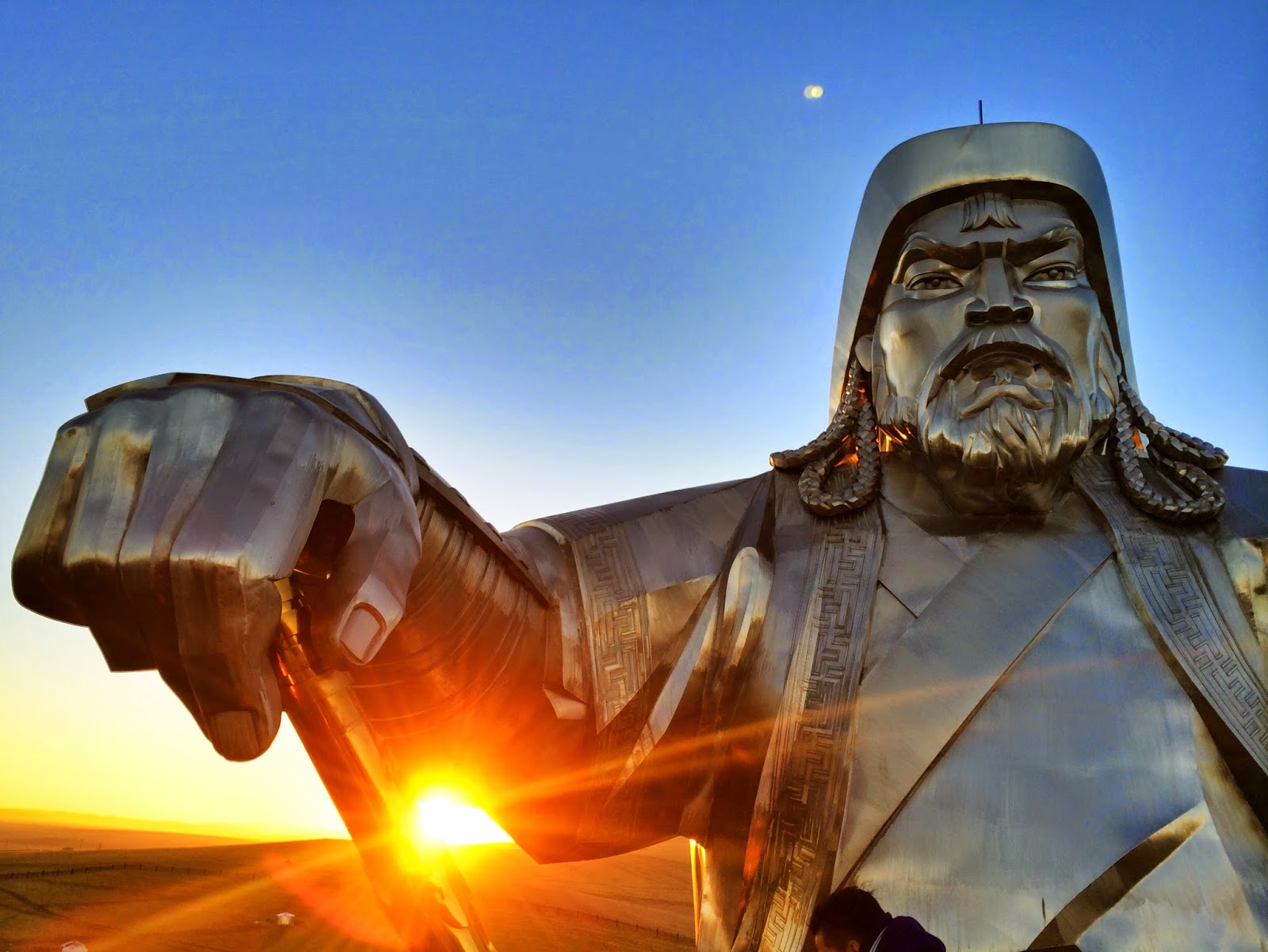
Immediately upon our arrival in the city, one of the fantastic people we worked with took us to the Chenggis Khaan (Mongolian spelling of Ghengis Khan) statue about 60 kilometers outside Ulaanbaatar. It’s really something. Rising out of a large, lonely plain flanked by mountains sits an enormous, very shiny stainless steel Chenggis Khaan on a horse. Only six years old, oversized, and very chrome-like, the horse warrior seems slightly gimmicky, but nevertheless imposing… and inarguably unique. The Mongols (as they call themselves) are proud of their long and legendary history, and since shrugging off the iron curtain have been free to pursue such expressions of their national pride. We made it to the statue just as the sun was setting over the steppe and from high in the horse’s head were treated to a spectacular panorama.


The rest of the week was filled working with one of the best groups of people I’ve been blessed to meet. Traveling to these places and experiencing (more often than not) the natural kindness, warmth and hospitality of people is one of the best parts of my job. We were also taken Mongolian cashmere shopping, which combined with my earlier experience with New Zealand wool, has instigated what I believe to be the start of a long and loving relationship with animal sourced fabrics… The Mongolian cashmere is unbelievably soft and luxurious, and while not a steal, still costs about 60% less than in the US. Let it suffice to say that my transformation to sheep was nearly complete on my trip home.

To cap off the short but almost impossibly rich week, we had the opportunity to go horseback riding in the Mongolian countryside. Occasionally, things in life that seem too good to be true… actually happen. For two and half hours, we followed our Mongolian guide, a boy of about 15, through the hills and prairies of the steppe. We forded icy streams, trotted past herds of yak and cattle and navigated rocky ledges, trailed the entire time by two frisky dogs from the horse ranch. It may be illusionary, but there was something so simple and natural in being atop a horse in this landscape that has been traveled by horse and essentially unchanged for eons. I usually have much to say and describe, but really my mind was unusually quiet during this ride. I already know I want to return to this land and see more, to see the sun set over the interminable Gobi dessert. 


Saturday, December 20, 2014

How to Dally in Dili

Someone who had been living in Dili for a few months told me that its slogan should be, “Dili keeps surprising you (in a good way),” and that seemed to be rather accurate. Dili is the capital of Timor-Leste, a small Asian Pacific nation attached to its West to Indonesia and perched above Australia. Timor-Leste is one of the youngest nations in the world, emerging in the early ‘90s after a long and often brutal struggle with Indonesia, preceded by Portuguese colonization, and followed by nearly a decade of UN control... So its independence was dearly fought for and only recently realized, with its identity and language going through a series of transitions.

Dili was an entirely pleasant place to spend a week in late October, balmy and humid, right on a beach lined with palm trees, with remarkable coral reefs and aquatic life accessible from the shore. Diving is a paradox, allowing you to visit a very foreign world and yet feel so natural. Except for the few humans that go into outer space being underwater is the closest we can get to the experience of weightlessness. There is nothing in the world like suddenly finding yourself surrounded by a flashing silver tornado of schooling fish, with choreographed movements that make them seem like one large, connected organism. It’s a trip to share their world, if even for the 50 minutes or so odd limits of an oxygen tank. 

After completing my Open Water certification (yay!), I went night diving on Halloween, isn’t that perfect? We paddled out on impossibly smooth water, along a pier flitting with bats to the descent site. The base of this reef was simply trash thrown off the pier, like old tires that happen to make great habitat (and hiding places) for creatures such as moray eels, gigantic puffer fish, and crabs. It was really quite eerie, swimming in the dark with just a flashlight suddenly bringing night creatures and coral and algae covered steel structures into view a few feet ahead, with the trembling light of a solitary pier lamp visible far above through 55 feet of water.

The land-based pastimes available in Dili include visiting the Christo Rei, a smaller version of Rio de Janiero’s Redeemer, high on a hillside overlooking the city. The sweaty climb to the top is via the 14 Stations of the Cross, and rewarded with a welcoming Jesus and panoramic views across the harbor.

I'd be amiss if I didn't mention the rather tiny "Tais Market" in the city center. Tais are stiff woven clothes unique to East Timor used for decoration and as clothing. When compared to many African markets, it was almost eerie how completely the vendors left me alone as I wandered through their stalls.

The many restaurants dotting the long beach road are popular diversions, where you can eat or drink either on or overlooking the beach, privy to spectacular sunsets, the soothing sound of lapping waves, or at night, the surprisingly good Timorese cover bands.

And finally sine this was Halloween week afterall, on a hot, sunny Sunday morning I made my way by foot and taxi through local neighborhoods to the Santa Cruz Cemetery. This was the site of a massacre credited with turning the tide in the fight for independence, where the Indonesian Army shot and killed over 100 peaceful protesters. Occupying a relatively small lot of land, the cemetery is fascinating in both the quantity and elaborateness of the tombs. It was difficult to find half a foot of path to walk on, as the graves are packed in so tight.